Welcome to the Henry A. Kissinger Center website!
The website is currently undergoing a refresh, and development is in progress.
 The Paul H. Nitze School for Advanced International Studies (SAIS) is pleased to announce the opportunity for outstanding scholars to conduct research in Washington, D.C., on “The United States, Europe, and World Order.”
During the academic year 2026-2027, up to two post-doctoral fellowships will be awarded. Both fellowships will be available for a minimum of nine (9) and maximum of twelve (12) months between July 1, 2026 to June 30, 2027. Applicants should indicate their preferred start and end dates in the application.
DAAD Post-Doctoral Fellows are closely integrated into the SAIS academic community and will be affiliated with the Henry A. Kissinger Center for Global Affairs. A division of Johns Hopkins University, SAIS is a global institution that provides interdisciplinary professional education to prepare a diverse student body for internationally related positions of responsibility; to foster research, scholarship and cross-cultural exchange; and to contribute knowledge, expertise, and leadership to the global community.
The Henry A. Kissinger Center for Global Affairs is home to a distinguished faculty of scholars and practitioners working to address some of today’s most complex global challenges. Through its innovative research, curricula, and programs, the Kissinger Center seeks to integrate historical scholarship with rigorous analysis of geostrategy and statecraft.
The Fellowships are funded through a grant from the German Academic Exchange Service (DAAD) with the generous support by the German Federal Foreign Office.
During the academic year 2026-2027 research and related activities will focus on “the roles of the United States and Germany at a crucial moment in world history.” DAAD Post-Doctoral Fellows will focus on this subject during a regular series of high-level seminars, peer review sessions, and opportunities for direct engagement with senior foreign policy practitioners and leading scholars of statecraft and world order. Each Fellow is expected to complete a research paper related to the theme during the period of residence in addition to continuing to work on their own research projects. The Fellows will also work with the Helmut Schmidt Distinguished Visiting Professor and the Kissinger Center on a German-US conference on issues of international security, historically informed statecraft and strategy and/or transatlantic relations taking place in Germany and a summer workshop on grand strategy and international security for early career academics and policymakers in Washington, D.C.
Eligibility
Applicants for the DAAD Post-Doctoral Fellowships at SAIS must have a doctorate or be at the post-doctorate level, have demonstrated research capacity, and be fluent in English. EU and U.S. citizens are welcome to apply. EU citizens should be currently affiliated with a German university or research institution and be eligible for a J-1 visa. Preference will be given to those who are no more than 6 years beyond completing their dissertation, although others are also eligible.
Salary
Each DAAD Post-Doctoral Fellow will receive a monthly salary of up to $6,000, minus U.S. taxes; access to a computer and shared workspace; internet access; access to Johns Hopkins University libraries and other facilities. Each Fellow is expected to take care of his/her accommodation and living expenses. A basic health care package is available for all Post-Doctoral Fellows. For non-US citizens one economy class roundtrip airfare will be provided. Furthermore, research funding of up to $3,000 for a 12-month stay will be available for each Fellow as well as one economy class roundtrip airfare to the above-mentioned conference in Germany. Health benefit premiums for accompanying dependents can also be covered ($560 per month if one dependent or $880 per month if more than one dependent).
Application Procedure
Each applicant should submit the following (in English):
- A statement of interest outlining why you are applying and what you hope to get out of this fellowship.
- A 3 to 5-page double-spaced research statement that proposes a research project, including its relevance to the theme “The United States, Europe and World Order.”
- Preferred appointment start and end dates, between July 1, 2026 and June 30, 2027.
- A curriculum vitae.
- Three references with contact information.
The applicant is responsible for collecting all materials and submitting them before 23:59 EST on January 14, 2026 using the following application portal: https://apply.interfolio.com/177831.
Applicants will be notified of their acceptance in February 2026.
The 2026-2027 DAAD Post-Doctoral Fellowship begins between July 1 and October 1, 2026 and concludes on June 30, 2027 with the possibility of renewal for an additional twelve (12) months upon mutual agreement. For further information please visit the program website, the Kissinger Center website, or write to [email protected].
The Position
In 2018, with funding from the German Federal Foreign Office, the German Academic Exchange Service (DAAD) established a Distinguished Visiting Chair in honor of former German chancellor Helmut Schmidt at the Henry A. Kissinger Center for Global Affairs, an international policy center at SAIS. The Chair commemorates the long and deep friendship between Kissinger and Schmidt and constitutes the core of a Germany Initiative that acts as a bridge between Germany and the US. The initiative also aims to become a focal point for German and American cooperation in addressing global challenges.
The distinguished scholar selected for the chair will partner with faculty within the Kissinger Center and other programs at SAIS. The visitor may also establish a research group, comprising several post-doctoral students. The scholar will further collaborate with other SAIS faculty (1) to build a research program capable of harnessing transatlantic cooperation to tackle geostrategic global challenges; (2) to devise a curriculum to educate and train future generations of world leaders; and (3) to conduct an active program to engage U.S., European and global policy professionals in this work. Together with Kissinger Center staff the chair will actively support two DAAD post-doctoral fellows at the Kissinger Center whose research will focus on the roles of the United States and Germany at a crucial moment in world history. Together with the postdocs the chair will work on initiatives of high visibility, such as an annual high-level German-US conference in Berlin as well as a regular summer workshop for early career academics and high-level policymakers in Washington, D.C.
Qualifications
To occupy the Helmut Schmidt Chair, SAIS is seeking a distinguished scholar who has made (or has the potential to make) an important impact on our understanding of contemporary global challenges and whose research is innovative and policy-relevant. Scholars in fields consistent with Kissinger’s broad, eclectic approach to the analysis of international affairs, including but not limited to strategic studies and diplomatic history, are encouraged to apply. It is preferred that the scholar be well grounded in historical approaches to the understanding of global statecraft and strategy, and also be able to communicate with a broad audience. Individuals with a research agenda touching on transnational issues of global concern such as climate change, migration and immigration, regional integration and globalization, and international / transatlantic security policy will receive special consideration. Candidates should have a research focus on Germany and proven expertise concerning Germany’s international relations with Europe and the world – in particular its transatlantic relations – to forge strategic links with international policymaking circles and draw attention to Germany’s accomplishments and the lessons they hold for long-term strategic analysis. Also, candidates should be affiliated with a German university or research institution in order to build a bridge between Germany and the U.S.. Prior experience within a U.S. academic and policy environment is a plus.
The contract is flexible, comprising an initial one-year term with the possibility of renewal. The scholar will be expected to fulfill a teaching role in Kissinger Center curriculum and seminars. The preference is for a scholar at the full-professor level, but promising candidates at the associate professor level will also be considered.
Application
Applications will only be accepted through Interfolio. A letter of application and motivation, curriculum vitae, and the names and contact points of three references should be included. Applications for the 2026–2027 academic year will be accepted up until January 31, 2026. Johns Hopkins University is an equal opportunity/affirmative action employer committed to recruiting, supporting and fostering a diverse community of outstanding faculty, staff and students. All applicants who share this goal are encouraged to apply. The application link is below:
https://apply.interfolio.com/176910
Background
A division of Johns Hopkins University, the School of Advanced International Studies (SAIS) is a global institution that offers students an international perspective on today’s critical issues. For more than 75 years, Johns Hopkins SAIS has produced great leaders, thinkers, and practitioners of international relations. Public leaders and private sector executives alike seek the counsel of the faculty, whose ideas and research inform and shape policy. Johns Hopkins SAIS offers a global perspective across three campus locations: Bologna, Italy; Nanjing, China; and Washington, D.C. The school’s interdisciplinary curriculum is strongly rooted in the study of international economics, international relations, and regional studies, preparing students to address multifaceted challenges in the world today. For more information, visit sais.jhu.edu.
Since its founding in 1925, the German Academic Exchange Service (DAAD) has awarded funding to more than 2.7 million scholars in Germany and abroad. DAAD is a registered members’ association made up of German institutions of higher education and student bodies whose activities go far beyond simply awarding grants and scholarships. DAAD supports the internationalization of German universities, promotes German Studies and the German language abroad, provides developing countries with best practices in establishing universities and advises decision makers in the area of cultural, educational and developmental policy. Today, DAAD is one of the most important funding organizations worldwide for the international exchange of students and researchers. For more information, visit www.daad.de.
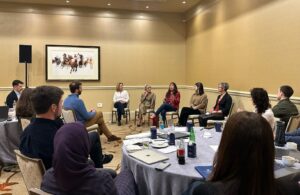
Leading scholars, policymakers, and think-tank experts gathered October 22–24 at the Salamander Resort in Middleburg, Virginia, for the Henry A. Kissinger Center for Global Affairs’ annual retreat as part of the International Policy Scholars Consortium and Network (IPSCON) program. IPSCON is funded by the Carnegie Corporation of New York.
The retreat brought together a diverse mix of emerging and established voices in international affairs for a weekend of discussion, collaboration, and reflection on the state of policy-engaged scholarship. Designed both as a workshop and a forum for forward-thinking dialogue, the event encouraged participants to challenge conventional wisdom and identify overlooked questions shaping today’s global landscape.
A highlight of the retreat was the discussion chaired by Dr. Kori Schake on leading successful organizations. The session featured accomplished scholars and practitioners Dr. Kathleen Hicks, Dr. Alina Polyakova, Dr. Alexandra Toma, and Dr. Janice Stein. The group shared strategies for integrating academic insight into practical leadership in their respective institutions and highlighted the importance of exercising adaptability while maintaining a clear mission.
This discussion, and the many others throughout the retreat, supported the Kissinger Center’s ongoing mission to foster a network of thinkers capable of translating ideas into impact in an increasingly complex international environment.

Thanks to the generosity of the Axel and Margaret Ax:son Johnson Foundation for Public Benefit, the Henry A. Kissinger Center for Global Affairs, located within the School of Advanced International Studies (SAIS) at Johns Hopkins University, is pleased to announce generous fellowships for visiting Postdoctoral Fellows pursuing scholarly research in historically informed statecraft and strategy. In addition to being part of SAIS, the Postdoctoral Fellows will join an exciting, international consortium, the Ax:son Johnson Institute for Statecraft and Diplomacy (AJI). The other members of the AJI are the Centre for Geopolitics at the University of Cambridge, the Centre for Grand Strategy in the Department of War Studies at Kings College London, and the Center for Statecraft and Political Communication at the Stockholm School of Economics.
Postdoctoral Fellows will work closely with the faculty and affiliates of the Kissinger Center and will have opportunities to participate in the Center’s activities and the broader intellectual communities of SAIS and JHU. The new scholars will also collaborate with faculty, affiliates, students, and Fellows from the other institutes in the consortium, creating a multi-institutional, multi- national intellectual community that spans the Atlantic, and will have publishing opportunities through Engelsberg Ideas.
The program will build and expand upon the Kissinger Center and SAIS’s strengths in diplomatic and military history, strategic studies, security studies, international relations, and economics and international political economy. SAIS is interdisciplinary and policy-engaged, and its location in Washington, DC, allows scholars easy access to major instruments of government, think tanks, and federally funded research and development centers, as well as important archives. SAIS also has campuses in Bologna (Italy) and Nanjing (China), providing additional opportunities to engage with the scholarly and policy communities in Europe and Asia.
Up to three Postdoctoral Fellows will be awarded a two-year fellowship that includes health insurance, research funding, and a competitive salary of $73,000 per year.
Eligibility
Postdoctoral Fellows are expected to start in the summer/fall of 2026 and continue for two calendar years, although a later start date can be negotiated for exceptional applicants. Please state your availability in your application letter. The Postdoctoral Fellow will be expected, in addition to pursuing his or her own research and writing, to contribute to the intellectual life of the Kissinger Center as well as the AJI consortium and to participate in their programming.
Applicants for AJI Postdoctoral Fellowships must have completed their PhD by the time they take up the fellowship and have a track record of excellent historically-minded research in statecraft, diplomacy, or strategy. Postdoctoral fellows are expected to remain in residence at the Kissinger Center for the duration of their fellowship. We encourage candidates with PhDs in history, political science, and international relations to apply, but other disciplines are also welcome. Applications from women and minority candidates are especially encouraged.
Application Instructions
Each applicant should submit the following:
1. An application letter explaining why you are applying, why and how your research interests align with the objectives of the AJI initiative, what you hope to accomplish during your time at the Kissinger Center, and your desired start date;
2. A curriculum vitae;
3. An article or writing sample on statecraft or strategy, broadly defined, which demonstrates a historically-minded approach to research;
4. Three letters of recommendation.
The applicant is responsible for collecting all materials and submitting them before 23:59 EST on January 2, 2026, using the following application portal: apply.interfolio.com/176067.
Applicants will be notified of their acceptance in February 2026.
On October 8, 2025, the Center for European Policy Analysis, Henry A. Kissinger Center for Global Affairs at Johns Hopkins SAIS, Hertie School, and Keio Center for Strategy co-hosted a trilateral dialogue on The Future of World Order at the Johns Hopkins Bloomberg Center.
The event brought together distinguished scholars and practitioners to reflect on the durability of the current global system amid growing geopolitical uncertainty. Dean James Steinberg provided opening remarks, and Professor Francis J. Gavin chaired the discussion.
Panelists included Professor Marina Henke (SAIS and the Hertie School in Berlin), Professor Yuichi Hosoya (Keio University, Tokyo), Christopher Walker (Vice President for Studies and Analysis at the Center for European Policy Analysis), and General Daniel Petrescu (former Chief of Defense, Romania).
The conversation opened with a reflection on the institutions and norms that have underpinned international stability since 1945 – many of which, panelists agreed, are under increasing strain.
The panelists then shared their analysis of where the postwar order stands today and what challenges threaten the stability of this order from the perspectives of Western Europe, Eastern Europe, and the Indo-Pacific region. They discussed shifts in the strategic focus of democracies amid growing feelings of fear and unfairness, and how those feelings have been heightened by unforeseen consequences of the digital age.
In closing, Prof. Gavin emphasized that today’s challenges demand more than economic solutions. Instead, they require a rethinking of global institutions, values, and purpose in a rapidly changing world.
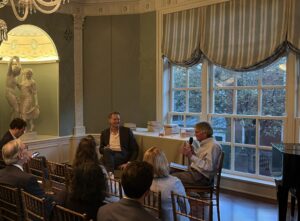
The Henry A. Kissinger Center for Global Affairs held a conversation with Dean James B. Steinberg celebrating the release of Prof. Francis J. Gavin’s new book, Thinking Historically: A Guide to Statecraft and Strategy.
Attendees included both scholars and foreign policy practitioners. The talk ranged from Henry Kissinger’s legacy as both a historian and a statesman, what Prof. Gavin gleaned from Dr. Atul Gawande’s “checklist manifesto,” and how we can spot faulty historical analogies in current policy debates.
The event took place on Monday, October 6 at a historic Georgetown home.